
We were featured in the Weave newsletter!
Breaking the ice when neighbors build walls
An Article from the Weave: The Social Fabric Project
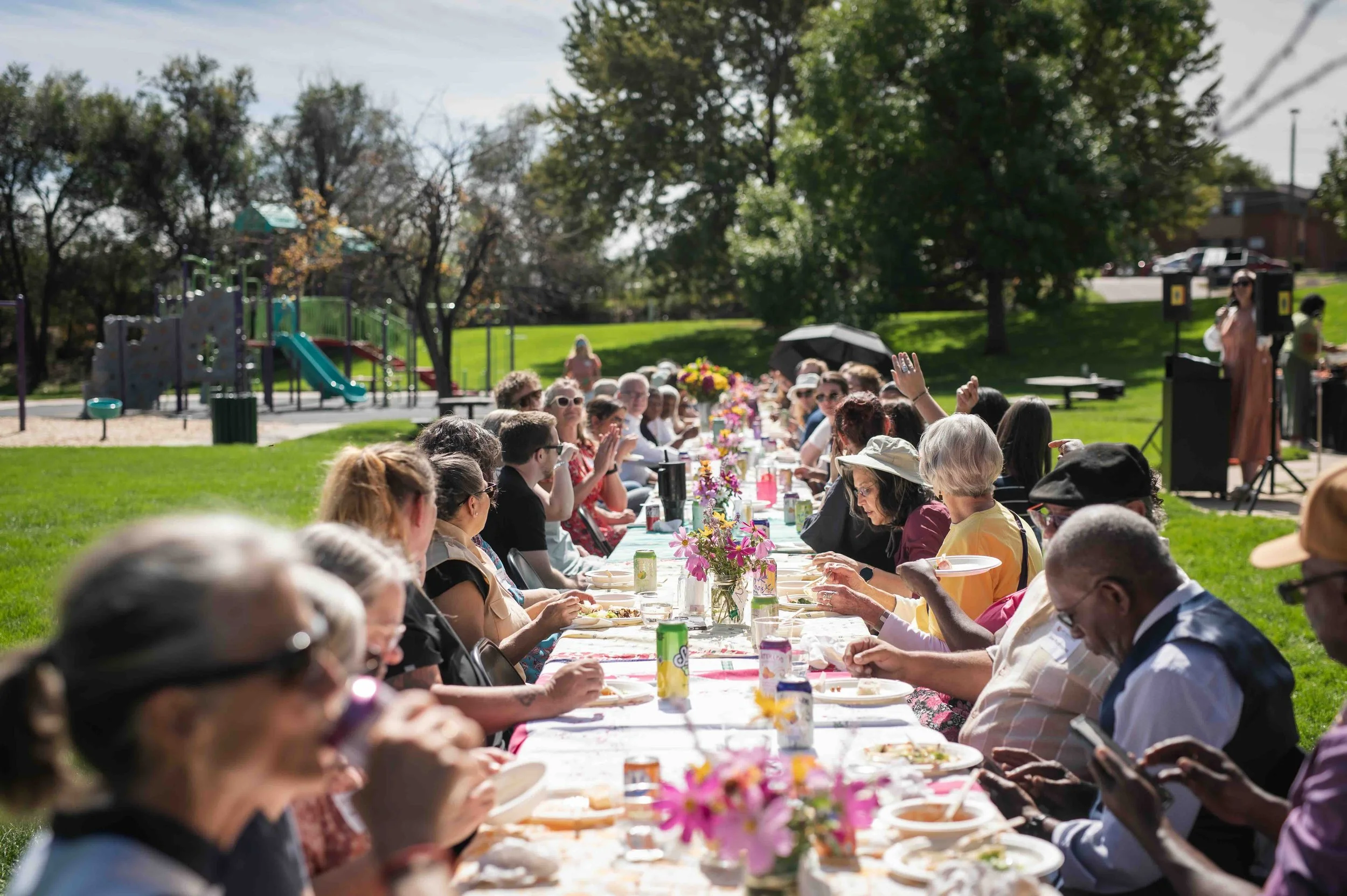
Neighbors gather together at a park for a community dinner in Colorado Springs, Colo. Photo credit: Hey Neighbors
When Kelly Bull moved to Colorado Springs, she experienced a profound culture shock. "Nobody talked to us at all," she recalls. “Months went by without even eye contact. No hello, nothing.”
The danger of living isolated from neighbors became apparent one morning when a SWAT team raided the house next door, with smoke bombs and guns drawn. "I realized, I don't have anyone's phone number," Bull remembers. "I couldn't check in on the next door neighbor, I couldn't ask the neighbor across the street if they could see what was going on.”
Bull, a former science teacher with a permaculture landscape design business, decided she had to change the ecosystem of her street. "If my neighbors weren't going to talk to me, I was going to give them something to talk about," she says. She began transforming her front yard into a water-wise "food forest" with fruit trees and berry bushes, turning her lawn into a conversation starter. She even friendly-stalked neighbors by figuring out when they came home from work, just to grab a chance to say hello. “It was that extreme,” Bull says. “It was just not the culture of the neighborhood to talk to each other."
Her first big breakthrough came with her next-door neighbor, Gerri. After six months of no interaction, she finally heard someone in the backyard behind the privacy fence. Bull shouted, “Hey, neighbor!” and asked to poke her head over the fence to introduce herself. Today, she and Gerri are close friends, sharing house keys and serving as each others’ emergency contact.
Bull’s next win came when she offered her landscape design services for free to one of her neighbors. They accepted and the result was a “planting party” that drew many neighbors and their friends. Since then, Bull has designed “food forests” for four other homes on her block.
Having had some modest success changing the social culture of her neighborhood, Bull wanted to do more. So she joined the board of the Council of Neighborhood Organizations, or CONO, and took their free 12-week civic education course called Neighborhood University. For Bull, the experience was transformative.
“You learn all about how the city functions and about different elements of the city, and talk to different people in different departments from the city,” she says. “I thought it was the most amazing program ever. I thought, if everybody in our city took this program how much better our city would be — if you understand why decisions are made, who's making the decisions and, if you want a different decision, how to insert yourself into the whole process."
CONO is now called Hey Neighbor and Bull has become the organization's Executive Director. Under her leadership, the organization runs initiatives like Neighborhood Cafes, which provide free coffee for gatherings of six or more neighbors, and the Neighborhood Network Program, which offers folks multiple ways to build relationships and connect with local leaders. This year, Hey Neighbor is working to mobilize Colorado Springs to participate in “150 Tables,” a state-wide initiative that aims to inspire residents to host neighborhood dinners and block parties.
Bull understands that change takes time and some people resist getting too friendly with folks around them. One woman explicitly told Bull that she felt safer not knowing her neighbors. But when Bull persuaded her to join a neighborhood cornhole tournament she organized, the woman not only had a great time — she won!
"She hung around afterwards to make sure to thank me," Bull says. "Once they get a little taste of what it's like to actually have real relationships with the neighbors… they change, and they choose it.”
Bull has learned that transforming her neighborhood’s ecosystem doesn’t require a grand plan. It can start with small actions, like saying hi to neighbors and inviting them to a shared activity. In her neighborhood, “a seed has been planted and now it's definitely growing,” Bull says. “One new person at a time in the neighborhood, we are changing the culture.”
