
Can Halloween Heal Us?
Article Written By: Melissa Teten
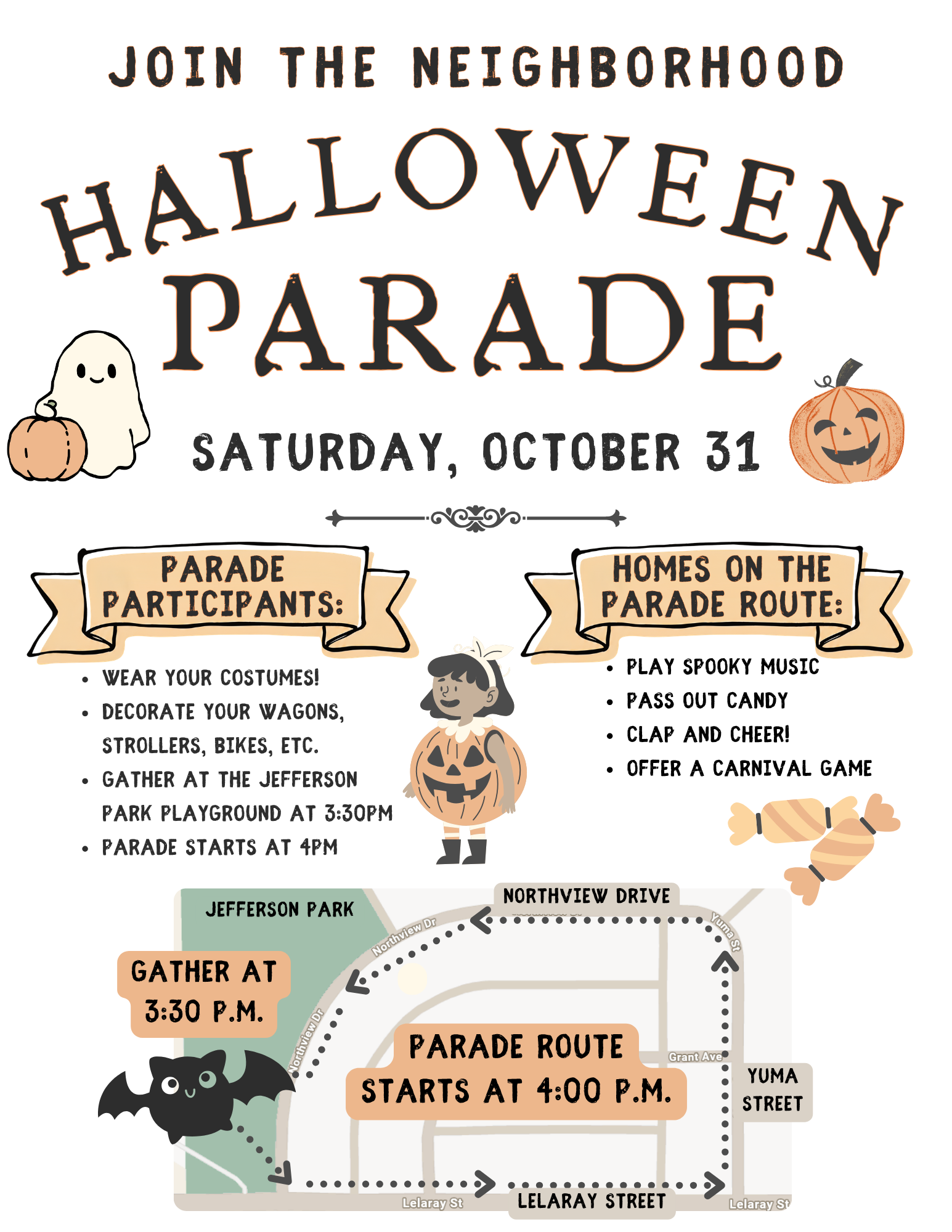
Meg’s neighborhood parade invitation. Attend, or host your own parade in your neighborhood.
A few years ago, as my husband and I walked our kids around the neighborhood on Halloween we noticed something we had never really thought about before:
Halloween might be the only national holiday that actually requires us to be neighbors.
Think about it. There is no other time of year when we spend an entire evening outdoors, walking from house to house, knocking on the doors of people we may or may not know—people who are expecting us and have prepared a little something sweet to offer.
From the outside looking in, it is a remarkably generous, community-driven, whimsical tradition.
And in a culture where loneliness and isolation have become increasingly common, there is something almost radical about it.
For one night, we leave our houses.
We walk.
We knock.
We open the door.
We say hello.
We give something away.
We receive something.
We keep moving down the street.
And that got us thinking: if we want to get to know our neighbors, we would be silly to miss the opportunity Halloween gives us.
So we decided that the following year, we would have a plan.
We would have an invitation ready to hand to our neighbors as they answered the door—an invitation to the next thing.
Maybe a block party. A cookie exchange. A chili cook-off. Happy-hour in the driveway.
The details didn't matter nearly as much as taking the opportunity to engage face-to-face while everyone was already outside, already expecting visitors, and already participating in something neighborly.
Halloween lowered the barrier to connection.
We just wanted to see if we could keep the door open after the candy was gone.
Of course, this is easier said than done.
Getting to know your neighbors—or stepping out on a limb and inviting them to something—can feel surprisingly daunting. What if no one answers the door? What if no one comes? What if you're the only person on the block who seems interested in knowing anyone?
And what if your neighborhood doesn't really do Halloween?
That's the roadblock local neighbor, Meg Yavara has run into in her neighborhood. Because there aren't many children trick-or-treating nearby, most families head to another neighborhood for Halloween.
But instead of accepting that as the end of the story, Meg decided to flip the script.
If the kind of neighborhood celebration she wanted didn't exist, she would create it.
This year, she's organizing a Halloween Parade—with flyers, a route, and invitations for neighbors to participate. She's inviting people to bring candy, music, games, and whatever else might turn a quiet street into a shared celebration.
I love this because Meg isn't waiting for her neighborhood to become the kind of place she wants to live in.
She's giving her neighbors an invitation to become it together.
And maybe that's the part of Halloween worth paying attention to.
The costumes and candy are fun. The ghosts and pumpkins are fun. Running around the neighborhood after dark with a pillowcase full of candy is, objectively, pretty great.
But underneath all of it is something much more meaningful:
We have a tradition that gives us an excuse to knock on one another's doors.
Maybe we shouldn't waste it.
Maybe the question isn't whether Halloween can heal the isolation we're experiencing. Maybe it's whether we can use the little openings for connection that already exist—and have the courage to create a few more.
So this Halloween, knock on the door.
Learn your neighbor's name.
Ask about the costume.
Hand them an invitation.
And if your neighborhood is quiet?
Make some noise.
Because sometimes being a good neighbor isn't about finding the community you're looking for.
Sometimes it's about being brave enough to start it.
